ALSO AVAILABLE THROUGH INSURANCE
Why HS Wounds Are Different
If you’ve ever tried to manage an Hidradenitis Suppurativa wound with standard dressings from a pharmacy and found that they regularly fall off, leak, hurt, or even make things worse, you’re not imagining it.
HS wounds are genuinely different. They develop in places most wound care products were never designed for, and they behave in ways that make conventional dressing solutions almost impossible to use effectively.
Understanding why HS wounds are different is the first step to finding wound care that actually works.
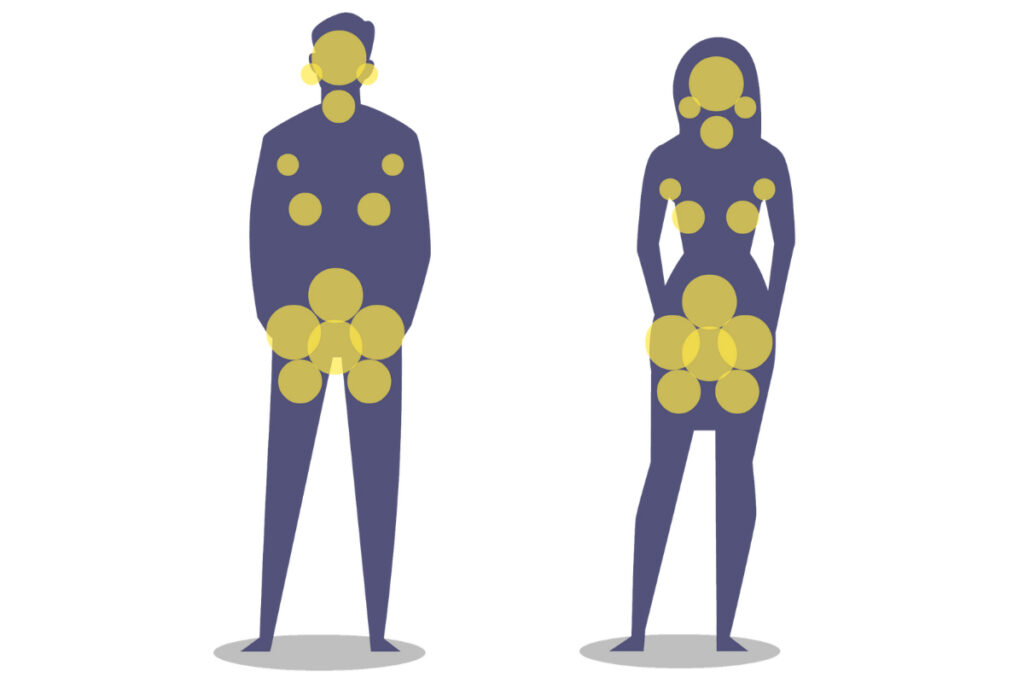
Where HS Wounds Develop
Most wound care products are designed for wounds on flat, relatively still areas of the body, a limb, a torso, a surgical incision.
Hidradenitis Suppurativa wounds are different. They often develop in places where skin folds and rubs skin-to-skin. Areas such as:
- Underarms (axillae)
- Groin and inner thighs
- Buttocks
- Under the breasts
- Abdomen folds
These are some of the most difficult areas of the body to dress. They flex constantly with everyday movement. They are warm and moist. They perspire. In many cases, they have hair, meaning adhesives struggle to grip properly.
For a standard adhesive dressing, this environment is almost impossible to manage.
Why Standard Dressings Don’t Work For HS
Walk into any pharmacy, and you’ll find rows of wound care products. But none of them were developed with Hidradenitis Suppurativa in mind, and it shows. Here’s what typically happens when HS patients use standard dressings:
- They don’t stay in place. Dressing adhesives struggle to stay attached to skin in warm, moist, mobile areas. Dressings shift, bunch, and peel away, often within hours.
- They damage the skin. Repeated removal of adhesive dressings from already fragile, inflamed skin causes a condition called MARSI – Medical Adhesive Related Skin Injury. This means skin stripping, pain, redness, and sometimes deeper tissue damage, on top of the HS itself.
- They can’t handle the drainage. Hidradenitis Suppurativa wounds frequently produce moderate to heavy exudate (fluid that standard dressings simply aren’t built to absorb). When a dressing becomes saturated, leaks happen. And for most HS patients, the anxiety around leaks is one of the most significant impacts on daily life.
- They’re not the right shape. Most standard dressings come in a 10x10cm square. HS wounds are rarely that shape, and rarely in a location where a square dressing can lie flat and seal properly.
The Drainage Challenge
One of the most misunderstood aspects of HS wound care is how unpredictable drainage can be.
Unlike a surgical wound or a simple cut, HS lesions can produce significant amounts of exudate, and the volume can change from day to day, or even hour to hour. Without the right dressing, this leads to leaks through clothing, odour, and the kind of anxiety that starts to limit where you’ll go and what you’ll do.
Research shows that Hidradenitis Suppurativa patients spend an average of eight hours per month managing dressing changes. That’s before work, before family, before anything else the day asks of you. On average, HS patients change dressings two to three times a day.
This is not a minor inconvenience. It is a significant, daily burden, and it deserves a wound care solution built to match it.
The Emotional Weight
The physical challenges of HS wound care are real. But so is the emotional impact.
When you can’t trust your dressing to stay in place, you start making decisions based on your wounds rather than your life. You turn down plans. You calculate how long you’ll be away from home. You worry about what might show through your clothes.
Studies confirm what HS patients already know: poor dressing confidence directly limits participation in work, exercise, and social life. It contributes to anxiety, isolation, and a lower quality of life, not because of the condition alone, but because the tools available to manage it haven’t been good enough.
You shouldn’t have to plan your life around your wound care.
What Good Wound Care Looks Like For Hidradenitis Suppurativa
Managing HS wounds effectively requires a completely different approach to standard wound care. The right solution needs to:
- Stay securely in place during movement, flexion and perspiration, without adhesive
- Absorb moderate to heavy drainage reliably, without leaking
- Avoid causing further damage to fragile, inflamed skin
- Be comfortable enough to wear all day, every day
- Be discreet under normal clothing
- Be manageable at home, ideally without assistance
HidraWear was designed from the ground up to meet every one of these criteria, because it was developed by someone who lives with HS.
You're Not Improvising Alone
If you’ve ever used sanitary pads, incontinence pads, gauze, or tissues to manage your Hidradenitis Suppurativa wounds, you’re far from alone. Studies suggest that many HS patients resort to non-medical materials simply because appropriate alternatives aren’t available to them, or they don’t know they exist.
There is no shame in that. But you deserve better.
Professional-grade wound care designed specifically for HS exists. And depending on where you live, it may be available to you through your healthcare provider at little or no cost.
Shop HidraWearUS Insurance InformationNext: Choosing the Right Dressing for HS →
Self-pay or Insurance- you decide!
As well as our self-pay shop, HidraWear is now also widely available through a broad range of Insurance providers including Medicare and Medicaid. It can be prescribed by your provider, billed directly to your insurer and delivered right to your door.